ESA XR Hackathon 2027

Build Extended Reality for Space.

A hybrid innovation event where university students, industry experts and XR developers team up with ESA to build XR solutions for space applications.

Online + Onsite (ESA ESTEC) 7 tracks Unreal Engine ESA XR Plugin

Mission brief

The event in a nutshell

What

XR for space, fast

Build modular ESA XR Plugin Components and XR space projects, and show how quickly impactful XR tools can be made. Virtual, Augmented and Mixed Reality solutions are welcome.

Who

Anyone

Any student, artist or professional enthusiastic about space, simulation, digital twins, game development, extended reality, 3D modelling, UX design, data visualisation or AI is welcome to join.

Where

Online, then onsite

The first phase runs online. The final challenge and award ceremony take place at ESA ESTEC in Noordwijk, the Netherlands. Venue details

How

Two phases, one goal

Build modular ESA XR Plugin Components online, then use the best ones in concrete space use cases onsite, showing how the ESA XR Plugin boosts and streamlines XR development for space.

01
Phase 1 · Online

Build a Component

1–31 March · Evaluation 1–15 April
  • Register by 25 February and join a mixed team. Registering alone? We will help you find one.
  • Design and prototype an ESA XR Plugin Component for one of the seven hack tracks, supported by the ESA XR-CC team.
  • ESA experts select the best-developed Components.
  • Winning teams are invited to ESTEC, with support for travel and accommodation.
Online phase details →
02
Phase 2 · Onsite

Build an XR Space Project

28–30 April · ESA ESTEC
  • By invitation only: the winning teams, up to 100 guests.
  • Combine the selected Components into concrete space use cases proposed by ESA experts.
  • Two days of building, then pitches and demos on the last morning.
  • The best projects win the final awards at the closing ceremony.
Onsite Finale details →
Flowchart
How the hackathon flows ESA hack tracks lead to many proposed Components in the online phase. ESA experts make a final selection of them, and at the Onsite Finale the selected Components are combined into XR space projects.

Use of AI. AI tools are welcome to help you code, design and create. Original and handcrafted content, such as your own 3D models, artwork, sound and code, will also be valued by the jury.

When

March – April

  • Registration deadline 25 February
  • Online phase 1–31 March
  • Evaluation 1–15 April
  • Winners announced 15 April
  • Prepare your trip 16–28 April
  • Onsite Finale 28–30 April


--Days
--Hours
--Minutes
--Seconds

Partners

Sponsors

Partner with ESA to support the next generation of XR talent for space. One package is available per tier.

Every tier includes
  • Official partner recognition
  • Acknowledgement during the event
  • Promotional material in participant communications*
  • Post-event recognition

Interested in sponsoring the ESA XR Hackathon? Contact us at xr@esa.int. In-kind support may also be considered.

* Supporter tier excluded. All branding, speaking, judging, mentoring and onsite activities are subject to organiser approval, programme fit and venue requirements.

Phase 1 · Online

Online phase

Teams design and prototype ESA XR Plugin Components for one of seven hack tracks. The best-developed Components earn their teams a place at the Onsite Finale at ESA ESTEC.

Registration closes 25 Feb Build 1–31 Mar Evaluation 1–15 Apr Up to 20 winning Components
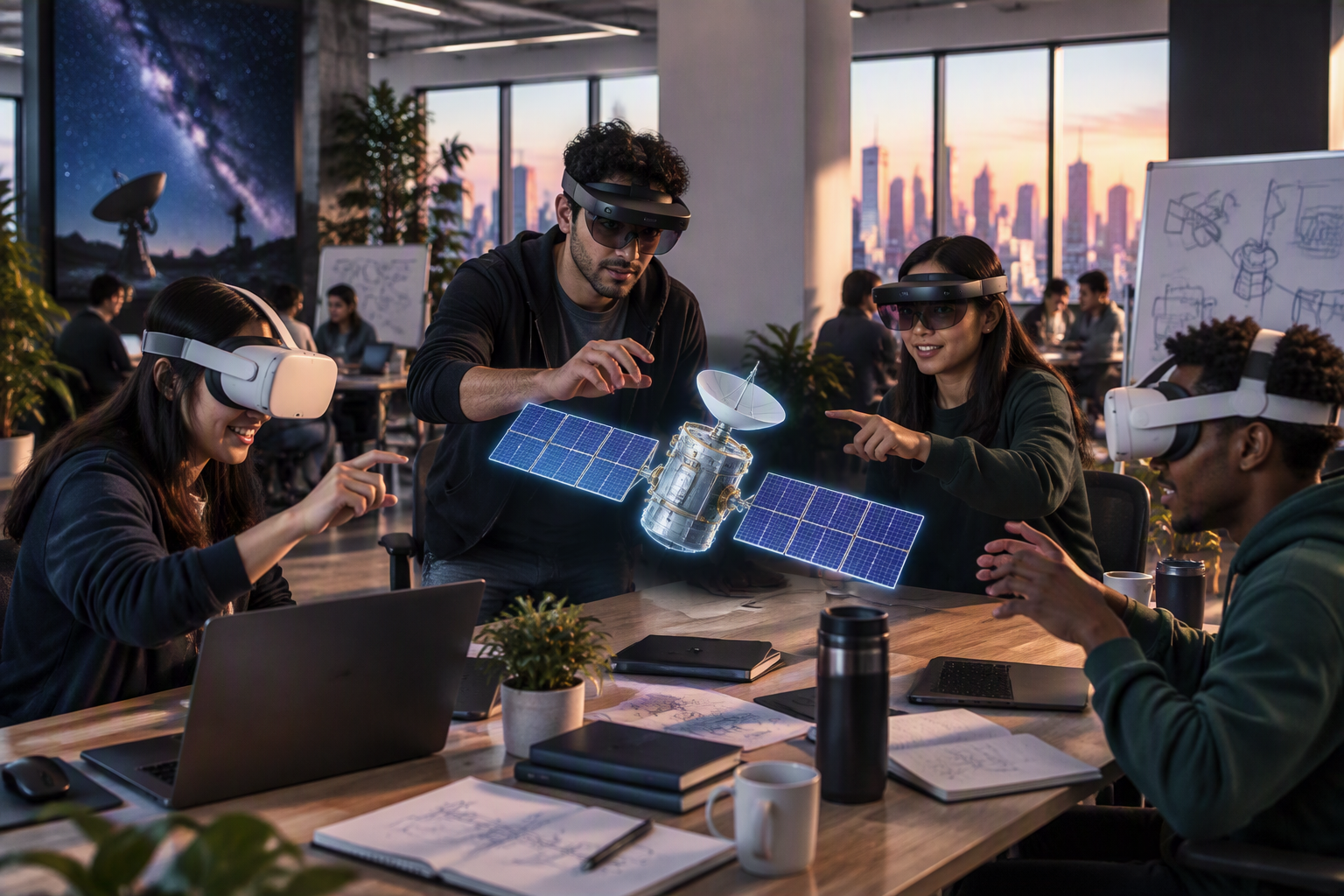
A team wearing XR headsets works together around a holographic satellite model above a table with laptops and sketches
The online phaseBuild your Component as a team, from anywhere

Choose your challenge

Hack tracks

These are the main topics the hackathon covers. Each developer or team can develop one or multiple ESA XR Plugin Components related to these tracks.

Track 01

Engineering & Digital Twin

Build immersive 3D, data-driven simulations of spacecraft systems. Connect real-time telemetry with XR to simulate spacecraft behaviour for early mission design and testing.

Component to developDescription
Revealed on 1 March
Track 02

Operations

Develop XR tools for mission control. Help operators visualise, command and interact with spacecraft and mission data in real time.

Component to developDescription
Revealed on 1 March
Track 03

Human & Robotic Exploration

Design XR systems for astronaut training and human-robot interaction in future exploration missions.

Component to developDescription
Revealed on 1 March
Track 04

Science

Create XR tools to explore astronomical and scientific datasets in new ways, making complex data intuitive and interactive.

Component to developDescription
Revealed on 1 March
Track 05

Earth Observation

Reimagine how scientists and analysts visualise and analyse Earth data using XR.

Component to developDescription
Revealed on 1 March
Track 06

Space Safety

Develop XR systems for monitoring and responding to space debris and planetary defence scenarios.

Component to developDescription
Revealed on 1 March
Track 07

Open Track

Not tied to a single domain, and with no predefined Components: propose your own idea. Open Track Components can be for general XR interaction, user experience (UX) or space-related use cases, as long as they are useful across ESA XR Plugin projects. They can be used in any of the XR space projects at the Onsite Finale.

Prize

Win your ticket to ESTEC

Prize for the selected winners

Travel support to ESA ESTEC

The teams behind the best-developed Components are invited to the Onsite Finale at ESA ESTEC in Noordwijk (28–30 April, up to 100 guests), with support for their travel and accommodation.

See the Onsite Finale →

Your guides

Workshops & technical mentors

The online phase starts on 1 March with two online workshops to get every team up to speed: the ESA XR Plugin in the morning and the hack tracks in the afternoon. After that, our technical mentors help all teams with the ESA XR Plugin, Unreal Engine and OpenXR.

Kick-off workshops

1 March · Morning · Online

Getting started with the ESA XR Plugin

In the morning, a hands-on introduction to the ESA XR Plugin: how to set it up in Unreal Engine, how its Components work, and how to create your own Component for the hackathon.

1 March · Afternoon · Online

The hack tracks

In the afternoon, the track mentors present the hack tracks and the Components to develop, share the context behind each one and answer your first questions.

After the workshops. From 1 March onwards, all communication with the technical and track mentors happens in the forum. Ask your questions on the board that fits them best, and the mentors will reply there.

Technical mentors

Andres Martin Barrio

Technical mentor

Fabrizio Ciolino

Technical mentor

David Reiter

Technical mentor

Andreas Treuer

Technical mentor

Florian Saling

Technical mentor

Martial Costantini

Technical mentor

Abhirup Bose

Technical mentor

Noora Archer

Technical mentor

Polona Caserman

Technical mentor

Phase 2 · Onsite

Onsite Finale

The winning teams of the online phase meet at ESA ESTEC, the European Space Research and Technology Centre in Noordwijk, the Netherlands. It is ESA's largest site and its technical heart. Together, teams combine the selected Components into concrete space use cases, showing how the ESA XR Plugin boosts and streamlines XR development for space.

28–30 Apr ESA ESTEC, Noordwijk By invitation only Up to 100 guests
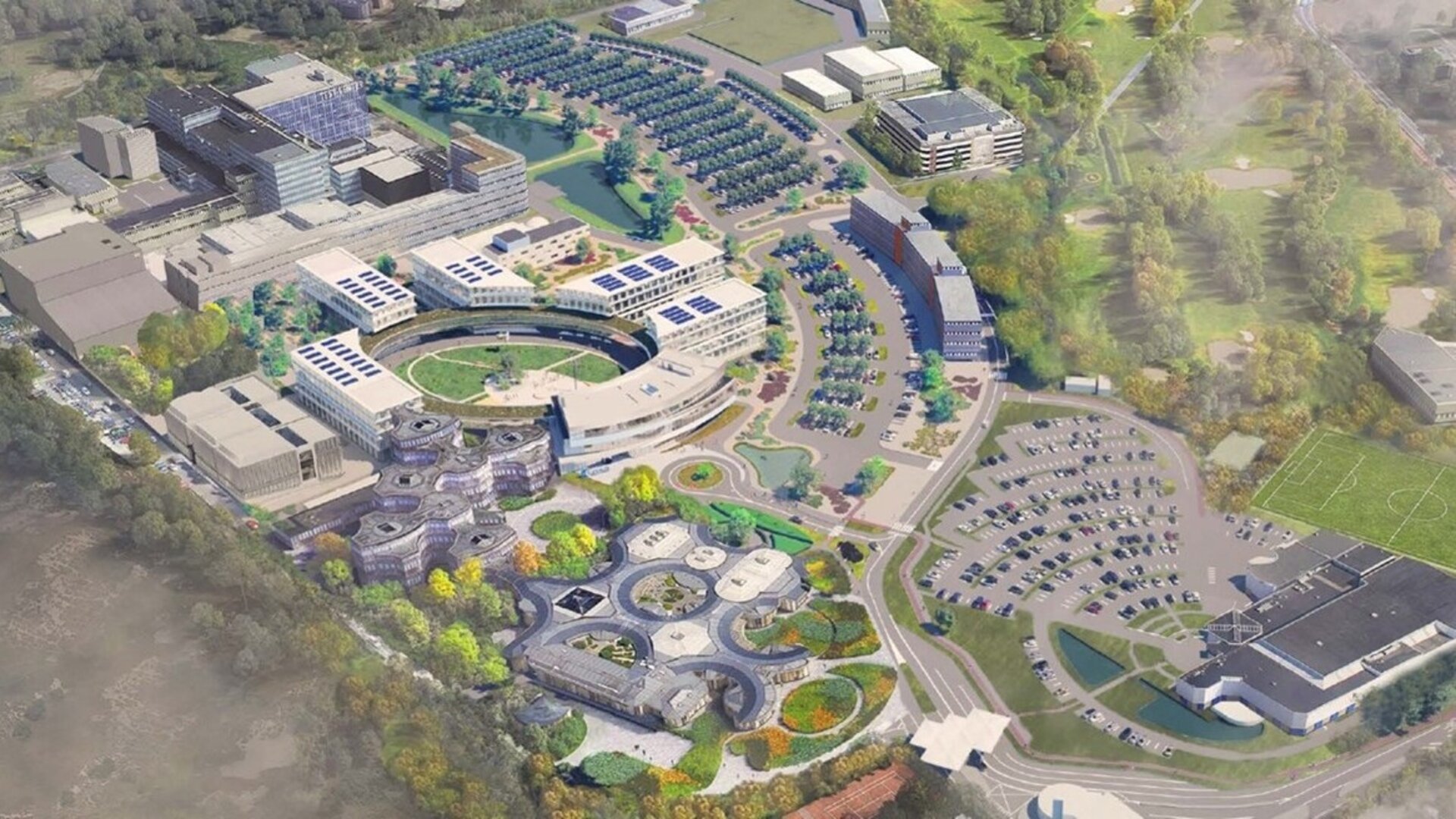
Aerial view of the ESA ESTEC campus in Noordwijk, with its office and laboratory buildings surrounded by dunes and greenery
The venueESA ESTEC, Noordwijk, the Netherlands

Rules of engagement

How it works

Phase 2 · Onsite Finale

Build an XR Space Project

  1. Participants. By invitation only: the winning teams of the online phase, up to 100 guests.
  2. Projects. ESA experts combine the selected Components into sample space projects: concrete use cases to build.
  3. Teams. Teams may reshuffle and choose which proposed project to work on.
  4. Build. Two days to design and prototype the project with the ESA XR Plugin Components.
  5. Pitch. Teams pitch and demo their projects on the morning of the last day.
  6. Judging. ESA XR experts and space XR industry experts judge the projects on purpose, quality of development and potential adoption in the space field.
  7. Awards. The award and closing ceremony takes place at the end of the last day.
Instructions

Before you come

  1. Invitation. The online phase winners are announced on 15 April and receive their invitation.
  2. Prepare your trip. Between 16 and 28 April, arrange your travel and accommodation with the support offered by ESA. Details come with your invitation.
  3. Bring your ID. A valid passport or ID card is needed to enter ESTEC.
  4. Bring your laptop. With Unreal Engine and the ESA XR Plugin installed and tested.
  5. Arrive. On 28 April, come to the ESTEC Gatehouse at Keplerlaan 1, Noordwijk. Bus 400 stops right in front of it. See getting there.

Choose your mission

Space projects

At the Onsite Finale, teams combine the selected Components into one of these XR space projects. Each project brings together one or more hack tracks around a concrete ESA use case.

Project A

XR for astronauts on the ISS

This project brings together science and human & robotic exploration. What makes it unique: its use cases are built for the Mixed Reality Facility (MRF), an adapted Meta Quest 3 headset that has been sent to the International Space Station. For science, XR can guide astronauts through experiments on board and help study how humans interact with virtual content in microgravity. Your project could become an XR application used by astronauts in space!

Hack tracks
  • Science
  • Human & Robotic Exploration
Highlight

Use cases for astronauts on board the ISS, with a headset already in orbit.

More details will be revealed during the Onsite Finale.

Project B

Keeping orbits safe

This project focuses on space safety. Low Earth orbit is getting crowded: tens of thousands of tracked objects and more than a million debris fragments larger than 1 cm orbit the Earth, each able to damage or destroy an active satellite. Every collision creates more debris, putting the satellites we rely on every day at risk. XR can help operators understand this complex 3D environment, assess collision risks and make faster decisions.

Hack tracks
  • Space Safety
Highlight

Visualise the debris environment and support collision avoidance decisions.

More details will be revealed during the Onsite Finale.

Project C

Preparing a lunar base

This project combines engineering & digital twin with operations. Teams work on the digital twin of a humanoid robot being deployed from Argonaut, ESA's lunar lander. On the Moon, the robot supports the deployment of modular experiments and the preparation of a future lunar base, while operators plan, monitor and control the mission in XR.

Hack tracks
  • Engineering & Digital Twin
  • Operations
Highlight

A digital twin of a humanoid robot and the Argonaut lander on the lunar surface.

More details will be revealed during the Onsite Finale.

Project D

Earth data for action

This project focuses on Earth observation. Teams build XR tools to review satellite data collaboratively, helping scientists and decision-makers fight climate change and respond to disasters such as floods, wildfires and earthquakes, where a shared understanding of the situation can save time and lives.

Hack tracks
  • Earth Observation
Highlight

Collaborative review of satellite data for climate action and disaster response.

More details will be revealed during the Onsite Finale.

Judging

Evaluation

Onsite projects are judged by ESA XR experts together with space XR industry experts on:

  1. Purpose

    How relevant and well-defined the project's topic and purpose are.

  2. Development

    A solid, professional development structure.

  3. Adoption

    Potential for adoption in the space field.

Jury members

Under consideration

Jury member

Prizes

Final awards

Prize amounts will be revealed in 2027

€
Grand Prize

Best Overall Experience

For the project that best combines purpose, quality and potential impact on space activities.

Category
€

Most Innovative

The most innovative experience or functionality.

Category
€

Best Integration

Best integration of Components into an application.

Category
€

Best UX & Design

Best user experience and design.

Category
€

Best Technical Achievement

Performance, stability, code quality and architecture.

Category
€

Greatest Impact

Greatest impact for ESA and space activities.

Venue & travel

ESA ESTEC, Noordwijk

The Onsite Finale and award ceremony take place at ESA ESTEC, the European Space Research and Technology Centre and ESA's largest site, at the southern tip of Noordwijk.

Address
ESA ESTEC
Keplerlaan 1
2201 AZ Noordwijk
The Netherlands

Dates
28–30 April

Open in Google Maps

Getting there

By plane

Fly to Amsterdam Schiphol. From there:

The ESTEC shuttle bus runs between Schiphol, ESTEC and hotels.

A taxi takes about 30 minutes.

Or take the train to Leiden Centraal (about 15 minutes), then bus 400.

By train

Travel to Leiden Centraal, then take bus 400 to ESTEC (about 30 minutes).

By bus

Line 400 (Leiden Centraal – ESTEC) stops at "Katwijk, ESTEC", in front of the Gatehouse.

Line 385 (Den Haag – Sassenheim) stops at "Schorpioen/Rijnsoever", about 300 m from the gate.

Plan your trip on 9292.nl.

By car

From Amsterdam: A4 towards Den Haag, then A44. Exit Noordwijk-Voorhout and follow the "ESA ESTEC" signs.

From Den Haag: A44 towards Amsterdam, exit 8 (Leiden), N206 towards Katwijk/Haarlem, exit Katwijk Noord, then follow the white "ESA ESTEC" signs.

Full directions on esa.int: How to get to ESTEC.

Three days at ESTEC

D1 Day 1

Kick-off & build

28 April
  1. Welcome and kick-off.
  2. ESA experts present the sample space projects.
  3. Teams reshuffle, pick a project and start building.
D2 Day 2

Build

29 April
  1. A full day of building with the ESA XR Plugin Components.
  2. ESA mentors support the teams.
D3 Day 3

Pitch & awards

30 April
  1. Morning: pitches and demos.
  2. Judging by ESA XR and space XR industry experts.
  3. End of day: award and closing ceremony.

Detailed timings will be shared with the invited teams.

Forum

Ask. Learn. Build.

Discuss in threads with other participants and the XR mentors, or find answers to common questions.

Forum

Community discussions

Pick a board, post your question and reply in threads. Sign in with GitHub to take part.

Board

General

Moderated by ESA XR-CC Attach files on GitHub

Discussions are hosted on GitHub Discussions via giscus. Posting needs a GitHub account, and GitHub's terms and privacy statement apply. For private questions, email xr@esa.int.

FAQ

Frequently asked questions

What is the ESA XR Hackathon 2027?

A hybrid innovation event to speed up the development and validation of Extended Reality (XR) solutions for space applications. Participants build modular ESA XR Plugin Components online, and the best teams build full XR space projects at the Onsite Finale.

Who can participate?

University students, industry professionals and XR developers interested in applying XR to the space sector can join the online phase. The Onsite Finale at ESA ESTEC is by invitation only, for the winning teams of the online phase (up to 100 guests).

To get the ESA XR Plugin you must register on the European Space Software Repository (ESSR) with an email from an EU-affiliated organisation.

Do I need a team to register?

No. You can register on your own. During the online phase we encourage participants to form mixed teams based on background and skills, and we will help you find one.

What tools and hardware do I need?

The ESA XR Plugin is built on Unreal Engine and OpenXR and runs on Windows 11. Make sure your Unreal Engine version matches the one required by the plugin. It supports both desktop and XR applications, and it is hardware-agnostic.

Why does the ESA XR Plugin support only Unreal Engine, and not Unity or other game engines?

ESA wants to build on common building blocks to reach ambitious goals in the long term. To focus its efforts, a single engine was selected for the ESA XR Plugin. Unreal Engine was chosen for legacy reasons.

This does not stop companies working with ESA from using Unity or other game engines. The ESA XR Plugin is an optional tool to streamline XR development and not a requirement to do business with ESA.

How do I get access to the ESA XR Plugin?

Register on the ESSR, then email xr@esa.int to request access. See the ESA XR Plugin page for details.

What is an ESA XR Plugin Component?

A modular building block that can be added, removed or modified in any ESA XR Plugin project, for example Menu, Movement, Multiplayer or Procedures. In the online phase, your team designs and prototypes a new Component linked to one of the tracks.

How are the online Components evaluated?

From 1 to 15 April, the ESA XR Competence Centre and experts from ESA directorates evaluate all Components submitted during the online phase (1–31 March). Only these winning teams are invited to the Onsite Finale at ESA ESTEC (up to 100 guests), with support for their travel and accommodation.

What happens at the Onsite Finale?

The Onsite Finale runs from 28 to 30 April. ESA experts propose sample space projects built around the winning Components. Teams can reshuffle, pick a project, and build for two days. On the last morning each team pitches and demos, followed by the award ceremony.

Who owns what I build?

Contributors to the ESA XR Marketplace keep intellectual property and commercialisation rights over their Components. The full hackathon terms will be published with registration.

Where and when is the Onsite Finale?

The Onsite Finale takes place from 28 to 30 April at ESA ESTEC, Keplerlaan 1, 2201 AZ Noordwijk, the Netherlands. See the map on the Onsite Finale page.

Attendance is by invitation only: the winning teams of the online phase, up to 100 guests.

// No matching questions. Ask in the forum instead.

Developers

The ESA XR Plugin

An optional standard framework designed by ESA to streamline efforts, avoid redundancies, and focus on advancing XR solutions for space applications.

ESA XR Plugin

ESA XR Plugin

v5.7.4-beta | ~230 MB | Windows 11
ESA XR Example Project

Example Project

v5.7.4-beta | ~716 MB | Windows 11

It is a modular, building-blocks solution made with Unreal Engine and OpenXR, designed to be free, lightweight, easy to use, hardware-agnostic and focused on interaction.

Building blocks

ESA Components

The tool supports both desktop and XR applications. Its Components are modular and inter-compatible, so you can add, remove or modify them as needed. Click a Component to watch its video.

ESA XR Marketplace

Make your own Components

Be part of the ESA XR Plugin by creating your own Components. Contributors keep intellectual property and commercialisation rights. Check the hackathon's tracks for more information.

Get started

How to install

The ESA XR Plugin is distributed under the ESA Community License. To get it, register on the European Space Software Repository (ESSR) with an EU-affiliated organisation email, then email xr@esa.int to request access.

Make sure your Unreal Engine version matches the one required by the ESA XR Plugin.